
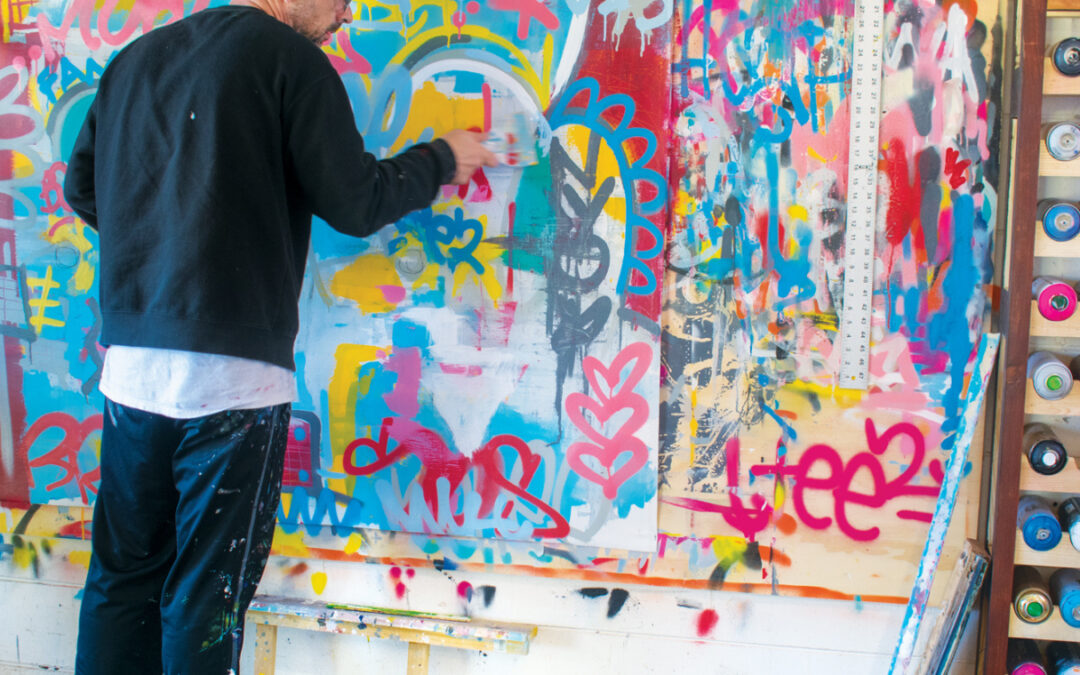

Graffiti matters because it is one of the last raw conversations happening in public space.
Before art fairs, before collectors, before framed pieces on white walls — there were trains, alleyways, bridges, and abandoned factories. There were young artists carrying backpacks full of spray cans and the idea that the world was a canvas waiting to be spoken to.
Graffiti did not ask permission to exist.
It appeared.
And in doing so, it changed how we think about art, identity, and public space.
A Language of the Streets
Graffiti is often misunderstood by people who only see it from the outside. To them it may look chaotic — overlapping names, arrows, drips, colors colliding with other colors.
But inside the culture, graffiti operates like a language.
Every artist develops a style of lettering that becomes their visual voice. The way a line curves, how an arrow cuts through a letter, the rhythm between thick strokes and thin fades — all of these elements form a signature that other writers instantly recognize.
A tag is the simplest expression of that language.
But even a simple tag carries layers of meaning.
It represents identity, territory, reputation, presence, survival
Over time those names repeat across walls, trains, and cities. What begins as a small mark slowly becomes a symbol known by an entire creative community.
Graffiti writers don’t just paint letters — they build visual identities.
The wall becomes a conversation. One artist writes. Another responds. Layers build over months and years, creating a living archive of expression.
To someone walking by, it might look like random marks.
But to those who understand the language, the wall is speaking.
The Most Democratic Art Form
Graffiti is one of the most accessible forms of art in the world.
You do not need a ticket to see it.
You do not need wealth to understand it.
You do not need a gallery invitation.
It lives in everyday spaces where life actually happens.
On the side of a corner store.
Under a highway bridge.
On the back wall of a factory.
Inside subway tunnels where thousands of people pass every day.
Because of this, graffiti democratizes art in a way few institutions can.
Traditional art spaces often create distance between art and everyday life. Museums place work behind glass. Galleries place it in quiet rooms where only certain audiences feel comfortable entering.
Graffiti removes those barriers.
It places art directly into the rhythm of the city.
A commuter might see a mural during a morning train ride. A kid walking home from school might pass a wall full of color and suddenly realize creativity can exist anywhere.
Graffiti doesn’t wait to be discovered – It confronts the world directly.
Rebellion Creates Culture
Some of the most important cultural movements in history began with rebellion.
Not rebellion for destruction, but rebellion for expression.
Graffiti grew from the same cultural roots as hip-hop in the 1970s. In neighborhoods where resources were limited and opportunities were scarce, creativity became a form of power.
Music came from turntables.
Dance came from sidewalks.
Art came from spray cans.
Writers transformed trains into moving galleries that carried their names across entire cities. What began as individual expression quickly evolved into a global movement.
Over time graffiti influenced nearly every creative industry:
- fashion brands adopted street lettering and graphics
- advertising borrowed the raw energy of graffiti aesthetics
- graphic design embraced spray textures and urban typography
- galleries began showcasing artists who once painted only on walls
Today, many of the visual elements born from graffiti culture appear everywhere — from luxury clothing lines to major brand campaigns.
Yet the core spirit remains unchanged.
Graffiti is still about voice.
Still about identity.
Still about creating something powerful with very little.
Why Graffiti Still Matters Today
In a world filled with carefully curated images, polished branding, and filtered digital aesthetics, graffiti offers something rare.
Authenticity.
It is spontaneous.
It is imperfect.
It is human.
Graffiti reminds us that art can still come from instinct rather than strategy.
A writer standing in front of a blank wall with a spray can is responding to something immediate — emotion, environment, identity, or simply the urge to create.
That moment of creation is deeply personal.
And when someone else passes by that wall and feels something — curiosity, inspiration, even confusion — a connection has been formed.
That connection is why graffiti continues to matter.
Because it proves that creativity does not belong only in controlled spaces.
It belongs wherever imagination meets surface.